
1910 Round 1, Carlton v Collingwood
Round 1 Saturday 30 April 1910, Princes Park
Carlton
639.9Collingwood
355.5Collingwood lost by 28 points.
Quarter by quarter
| Team | Q1 | Q2 | Q3 | Final |
|---|---|---|---|---|
| Carlton | 1.0 (6) | 6.4 (40) | 6.7 (43) | 9.9 (63) |
| Collingwood | 0.2 (2) | 2.2 (14) | 4.5 (29) | 5.5 (35) |
- Quarter time-4
- Half time-26
- Three quarter time-14
- Final siren-28
Collingwood's lead in points at each change; below zero, it trailed. Gold is the final margin.
- Venue
- Princes Park
- Date
- 30 April 1910
The side
Everyone who played, side by side. Open a player for their career.
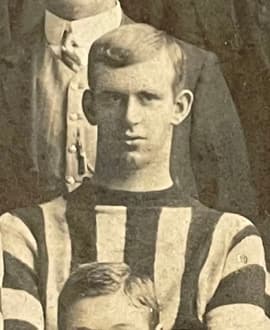


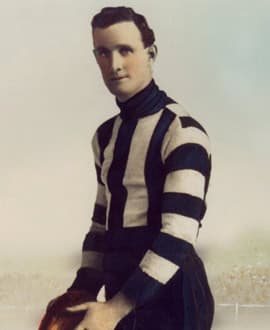
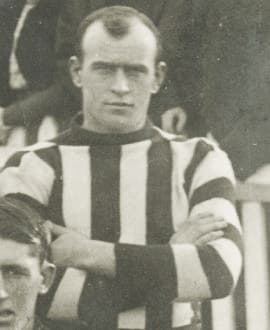


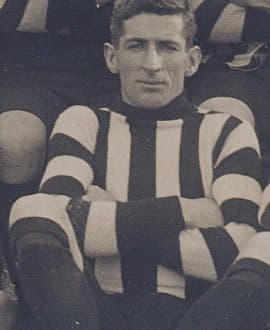


Player statistics
Collingwood players only. A black cell marks the team's best in that column.
| # | Player | GL |
|---|---|---|
| Dave Ryan | 1 | |
| Dick Lee | Team best: 3 | |
| Jock McHale | 1 | |
| Totals | 5 |
Match report
CARLTON'S STRONG SIDE.
TOO GOOD FOR COLLINGWOOD.
Carlton are still a strong side. The loss of several veterans has not apparently in the least weakened them, though no club can lose a man like "Mallee" Johnson without being the worse for it. It is in the desperate games that Carlton may realise their loss. With a team that is individually strong, and has had the benefit of sound drill and long experience, the loss of a few warriors falls far short of being a calamity.
It was expected that they would find strong opposition and a good game against Collingwood. We generally anticipate good system from a Collingwood team, but on this occasion the general ship was all on the other side. It was soon evident that a footballer like Augus, who is always in the stress of it rather than looking on, cannot be an efficient captain.
Although Collingwood had the wind with them at the start, Carlton were quicker in settling down to work, and Topping, marking right in front, scored their first goal promptly. But it was the perfection of Carlton's defence that chiefly won the admiration of the onlookers. Their direction under difficulties was always faultless.
They had Gotz placed half-back, well out on the wing. They played for him almost constantly, and he very rarely failed them. Collingwood were able to rush a couple of behinds, but the ball crossed the goal-line only three times in the quarter.
Although Collingwood wasted no opportunities against the wind in the second quarter, Carlton were too strong for them. Instead of sending Gotz back with the change of disposition they kept him in his old spot, where he was a great help to their forwards, and got a pair of goals from running screw kicks.
Carlton looked like finishing this term with a good six goals lead. Just towards the end of the term Collingwood got their chance, and used it. Lee, their goal-kicker, went down in a crush of players. His resistance, I think, was not too earnest; he played for the free kick and got it, as well as the goal with a very fine shot.
A minute afterwards both sides made the mistake of assuming that the ball was out of bounds. The umpire called "players" and the ball was promptly passed across to Lee, who, with another very clever shot from a `sharp angle, got Collingwood's second goal. They were, however, obviously beaten in hand-ball, and should none of their old celerity in betting rid of the ball to advantage in a difficulty.
When playing against the wind, Carlton always kept the play on the right flank for scoring- an important yet an elementary point which their opponents overlooked.
In the third term Collingwood, realising their position battled desperately hard, Angus especially doing fine work for them. They made some headway in getting 2 goals 3 behinds to Carlton's 3 behinds, but it was not nearly enough to give them a winning chance.
Although Payne had left the field with an injured leg, Carlton were better than Collingwood at almost every point, and put up 3 goals 3 behinds in the closing quarter, while just towards the finish of the game Lee got another goal for Collingwood.
Individually the Carlton men played a good even game, and the perfection of the half-back line was, one of the beat points in their organisation. It left Gillespie, the full back, very little to do, excepting to display his powers in kicking in. Payne, Harris, and Clarke were always prominent, with Gotz, as I have said, a tower of strength to them when against the wind. On the centre line, where Gregor will naturally be missed, they have found a very capable substitute in Macdonald, from the Yarraville team; but he will have to do much more before he can efficiently fill that gap. Lang and Bacquie were a fine pair of rovers, the last-named slightly the better of the two. If there was any failure in Carlton's work, it was on the forward lines. Wells, late of St. Kilda, was put into Carlton's ruck with Ford, and these two did a lot of hard, slogging plat. There was a great demonstration in Carlton's dressing room when Marchbank changed his mind at the last moment and put on the colours.
In Collingwood's ranks, Angus was undoubtedly the best man. McHaile played fairly well in the centre. Ryan and Vernon both worked hard in close play, but with rather less advantage to the side than usual. Lee was naturally very closely watched, but he is as sharp as a needle, and, making the most of the few opportunities given him, scored three goals. With the exception of Gibb and Freemm, there were no others on the side who showed to much advantage.
1910 'CARLTON'S STRONG SIDE.', The Argus (Melbourne, Vic. : 1848 - 1957), 2 May, p. 5, viewed 3 August, 2015, http://nla.gov.au/nla.news-article10853220
Suggest a correction
Know something we don't, or spotted a mistake? The club historians read every suggestion.